


Blog
What Is Alkaline Water? pH, Minerals and How It Is Made

Go to a supermarket today, and you’ll see various kinds of bottled water sold, like mineral water, purified water, spring water, filtered water – and now, alkaline water. The term “alkaline” can sound so different from the regular water you are used to, but what does it really mean?
Alkaline water is water that has a pH greater than 7 on the scale, hence alkaline. The alkalinity can occur naturally in the water as minerals are dissolved or can be produced during a water treatment process. These days, there are several trusted water suppliers in Jaipur like Kashaar, offering quality alkaline water to users. However, there is more to alkaline water than a number written on a bottle.
For example, two waters might be both alkaline, yet have entirely different mineral content, source and production processes. Knowing those distinctions can help you decipher labels on alkaline water and decide whether to consume it or not. This guide will help you understand the chemistry, minerals and manufacturing processes of alkaline water.
What is “Alkaline” water?
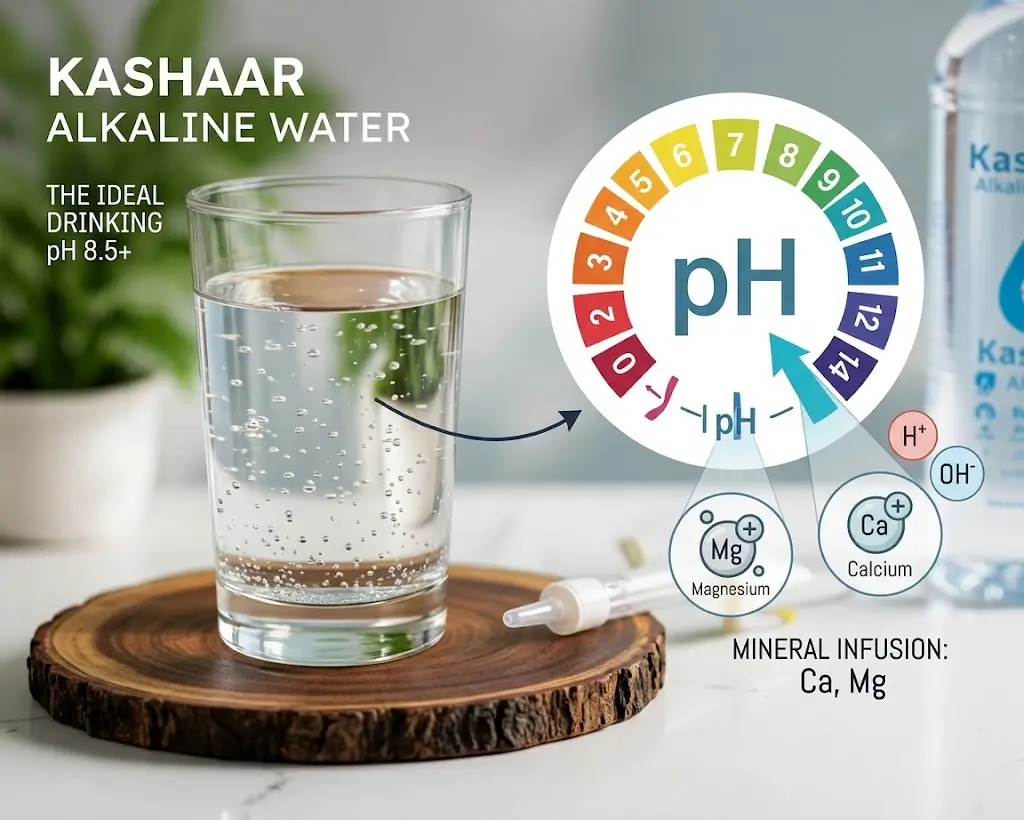
The pH scale is used to indicate the acidity or alkalinity of an aqueous solution. The pH value of 7 is considered a neutral value under normal conditions, and values higher than 7 are alkaline.
Therefore, if the pH value in the water sample is 7.5, 8 or 9, the water sample is alkaline.
But there’s an important difference between pH and alkalinity. pH is a measure of the water’s present acid-base state; alkalinity is a measure of the water’s potential to neutralise other added acid.
This difference can be significant when comparing naturally mineral-rich water and water which has had its pH adjusted by a treatment process.
Are the terms pH and Alkalinity the same?
They are frequently confused in common but are distinct and vary in water chemistry.
Suppose two water samples had the same pH of 8. They might not be composed of the same chemicals or react the same to the presence of an acid.
Why?
Alkalinity is very dependent on water constituents, which can react with and neutralise acids. In addition to bicarbonate and carbonate, other compounds can make a contribution.
This does not give the full story of the chemistry of a bottle by just reading the pH.
A pH 9.0 label does not tell you the amount of calcium, magnesium, bicarbonate or other dissolved matter present in the water. This is one of the reasons why it is wrong to compare alkaline waters through pH only.
Where is the Natural Alkaline Water From?
Not all alkaline water is manufactured. Water becomes alkaline naturally when passing through the soil and rock.
Water from rain starts its journey through the environment and can pass through layers of soil, rock and underground formations. In this event, it can leach some of the naturally occurring minerals.
The minerals found in the groundwater are dependent upon the geology of the area and may include:
- Calcium
- Magnesium
- Bicarbonate
- Potassium
- Sodium
These minerals are dissolved and can affect the pH, alkalinity, taste and mineral profile of the water.
That is why, even if all mineral waters are considered suitable for drinking, mineral waters from different geographical locations often taste noticeably different.
Why Do Minerals Matter in Alkaline Water?
Minerals are important in Alkaline Water because they are vital to your health. One of the most interesting components of alkaline water is the minerals that it contains – and they can affect more than just the pH.
Calcium – The mineral calcium is a critical component of bone and teeth growth and plays an important part in muscle and nerve health. Depending on the mineral content of the water, a small contribution to daily calcium intake can be obtained from drinking water.
Magnesium – It is important in numerous processes in the body, including normal muscle and nerve function. Certain mineral waters are a good source of magnesium.
Bicarbonate – The chemistry of naturally alkaline water is of particular interest to bicarbonate. It is alkaline and may affect the taste and buffering power of the water.
Sodium and Potassium – These are found in some mineral waters. Concentrations may be significantly different among products and sources.
There are also alkaline water sources that are low in minerals and others that are high in minerals. Water designed by Kashaar Alkaline water is the result of advanced purification and has rich antioxidant properties. Want to explore their range of products? Check out here for monthly subscriptions!
How is Alkaline Water Produced?
It’s not just about one way of making alkaline water! The pH, mineral composition and characteristics of the water could be affected by the production method.
1. Natural Mineralisation
Water naturally flows through geologic formations containing minerals and picks up some of the minerals along the way. The water can be slightly alkaline on its own accord, depending on the source.
Manufacturer may bottle the water as a product of treatment and meet quality control requirements at the source. The mineral content varies greatly from one source to another.
2. Adding Alkaline Minerals
Another method is to change the water chemistry through the addition of mineral compounds. Minerals or alkaline substances can be added depending on the product to raise the alkalinity.
This is because two products with the same pH may have different mineral profiles, depending on the minerals that are responsible for their alkalinity.
This makes the information about ingredients and minerals on the label even more useful for consumers than the number pH alone.
3. Electrolysis or Water Ionization
Water ionisers use an electrochemical process to produce water with different pH characteristics.
The water goes through an electrochemical system in which an electric current is applied to the water to drive ions between two plates in a membrane or other barrier. The streams formed can be of different acid-base.
An important point here is that the chemistry of the water is altered by its ionisation, and this is not an indication that the water has naturally dissolved minerals from a geological source.
4. Filtration Followed by Remineralisation
Some water-treatment systems filter out dissolved minerals and contaminants and then add specific minerals to the water. Remineralisation can affect:
- Taste
- Mineral content
- pH
- Alkalinity
Why Does Alkaline Water Taste Different?
Others find that alkaline or mineral water has a different taste from highly purified water.
Water that has minerals in it can alter its flavour and quality.
Calcium, magnesium, bicarbonate and other dissolved chemicals may contribute to the overall sensory properties of water, for instance.
That is why natural mineral waters can have unique flavours based on their origin.
No two alkaline waters taste, as there are many different combinations of minerals in the products.
What to check on an Alkaline Water Label?
When comparing products, don’t just take the pH number. Check for this information:
| Source | Does the water come from a spring, a water source other than a spring, a municipal water source or a different source? |
| Treatment | Did it get filtered, purified, treated with reverse osmosis, remineralised, or ionized? |
| Mineral profile | Check for calcium, magnesium, sodium, potassium and bicarbonate, if available. |
| pH | This will indicate whether the water is acid, neutral or alkaline and provide an approximation of the water’s acid-base |
| Safety and quality testing | Water with a high pH will not protect it from microbial or chemical contamination. The need for appropriate testing and treatment continues to be the key. |
Is Alkaline Water the same as Mineral Water?
No.
These are terms referring to various characteristics. Water that contains minerals is known as mineral water. Whereas the term alkaline water is mainly used to describe the acid-base properties (pH>7) of the water.
A water can be mineral-rich and alkaline, and an alkaline water can not be naturally mineral-rich. This distinction helps in reading the labels of the bottles of water.
Is Alkaline Water Safe?
Commercial alkaline water from a trusted source like Kashaar may be consumed by most healthy individuals as part of their fluid intake.
But it is not enough to say that water is safe just because of its pH. Microbiological and chemical contaminants, along with treatment, storage and distribution conditions, should be considered when developing safe drinking water.
There are also alkaline products that will be extremely alkaline and will not be something people need to pursue just because the pH is high.
People who have a medical condition that affects the function of the kidneys, electrolytes or acid-base balance, or have been advised to limit water or mineral intake, should consult with a health care professional about water options.
Where can I order Alkaline Water in Jaipur?
There are several water suppliers in the Pink City, but consumers often get stuck with choosing the right one. Before selecting the water bottles, always make sure the quality of the water is accurate and healthy.
Kashaar Alkaline Water is one of the reliable brands in Jaipur, which offers quality alkaline water to users of every location. Its water quality is good, and it is reviewed by TrustIndex. The water is generated with advanced purification and is certified by ISO as well as FSSAI.
If you are searching for alkaline water in this city and nearby locations, then you can get your monthly subscription online. From bottles to jars, they offer the water in every quantity as per your requirement. Explore the products here!
The Bottom Line
Alkaline water is not a completely new form of water. The pH is above 7, but what makes it alkaline becomes interesting. As natural alkaline water travels through geological formations, it may pick up a lot of minerals, which can give it some special properties. Other alkaline waters can be generated by mineralising the water, by ionising water, by purifying and then remineralising.
That’s why it’s important not to just consider the pH. The pH 9 label on a bottle just informs you that the water is alkaline; it doesn’t give you the full mineral profile, its source or what processes the water has undergone to make it alkaline or its overall safety.
When selecting alkaline water, don’t take the nameplate number as your sole indicator. Take into account the source of the water, treatment, minerals present, and adequate quality testing. Kashaar Alkaline Water is one of the trusted water suppliers in Jaipur for its quality-oriented alkaline water.